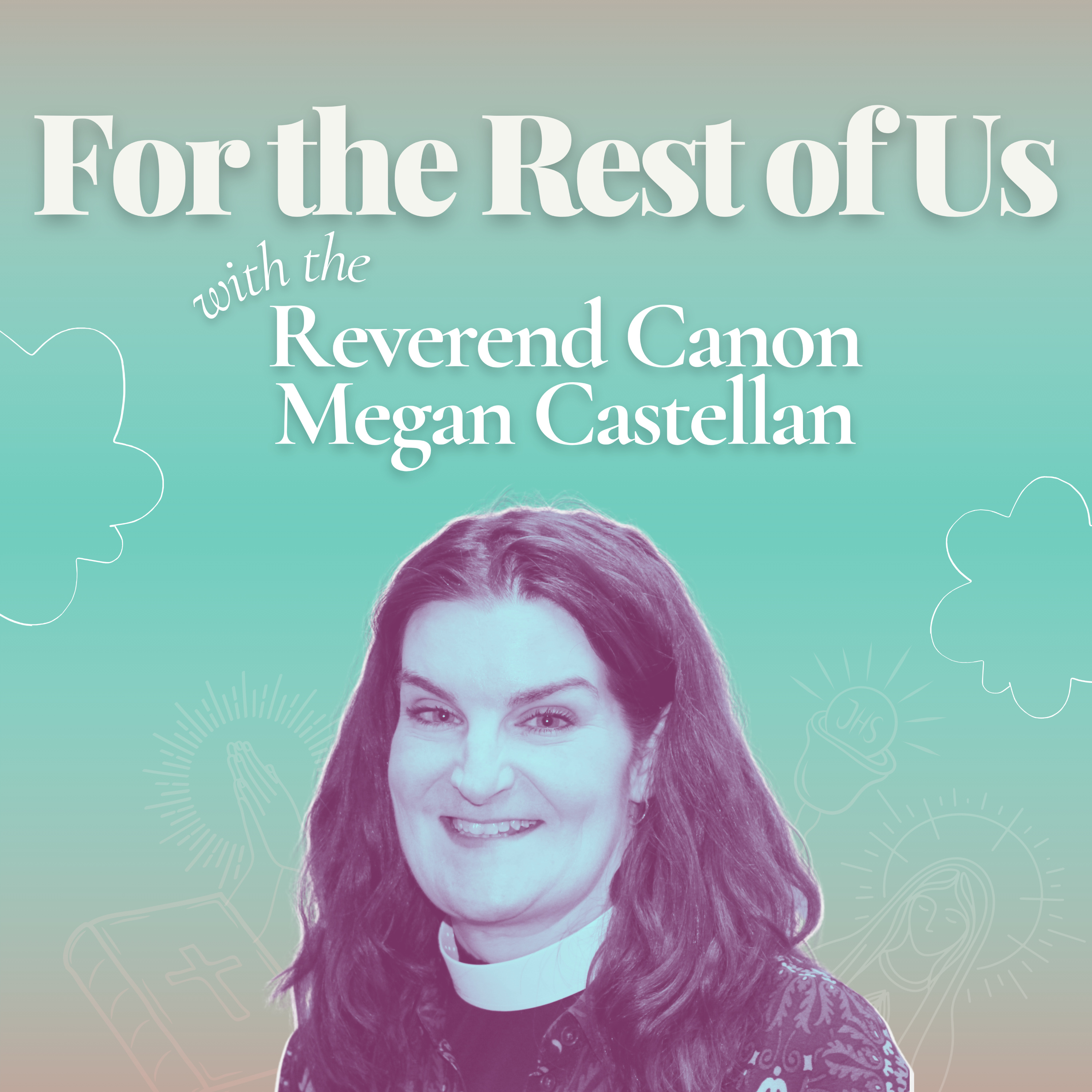
.png)
Speaking of Faith with Bishop DeDe
Welcome to Speaking of Faith with Bishop DeDe where we’ll connect faith questions and insights with the everyday realities of modern life. Join us on a transformative journey as we explore key theological concepts and their relevance to our daily lives, intentionally working to partner with God in healing the world with love.
Delve into the depths of religious thought in the Episcopal tradition, uncovering diverse perspectives and philosophical insights. Engage in meaningful discussions on topics like ethics, spirituality, and fighting dehumanization. Bishop DeDe and the occasional guest will demystify theological complexities (and yes, even nerd out a bit), empowering you to apply these profound principles in your life. Together, let’s dig into the deep and old mysteries of faith and foster a deeper understanding of ourselves and our world. Tune in for transformative experiences and rollicking discussions with Speaking of Faith with Bishop DeDe!
Speaking of Faith with Bishop DeDe
How Resurrection Reveals Hope
Use Left/Right to seek, Home/End to jump to start or end. Hold shift to jump forward or backward.
In this episode, Bishop DeDe and Adam explore what it means to talk about resurrection in a world filled with grief, uncertainty, and doubt. Rather than offering simple answers, they reflect on how resurrection is not just something we celebrate at Easter, but something we experience in real and tangible ways—often in the midst of life’s hardest moments.
They discuss the challenge of holding joy and sorrow together, especially during the Easter season, when celebration can feel at odds with the realities of the world around us. Through reflections on scripture, including the significance of the empty tomb in the Gospel of Mark, they invite listeners to consider how faith is shaped not by certainty, but by curiosity, questioning, and a willingness to live in the unknown.
The conversation also explores how resurrection shows up in everyday life—in moments of healing, in restored relationships, in glimpses of hope that break through grief, and in the quiet renewal that comes with each new day. Drawing from personal experiences of loss, they reflect on the enduring nature of love and how even in death, connection is not lost.
Join us in reflecting on how resurrection is not just something to believe in, but something to notice and experience. May this conversation encourage you to embrace both faith and doubt, to remain open to transformation, and to trust that even in the most difficult moments, the worst thing is never the last thing.
AI Disclosure: To support our staff in their limited time, some of our episode summaries are first generated by AI and then edited by the Communications Director to accurately reflect and preview our podcast episodes.
Bishop DeDe Duncan-Probe (00:02.402)
Hey friends, welcome to the podcast, Speaking of Faith. My name is DeDe Duncan-Probe. I am the Episcopal Bishop of Central New York, Canada to Pennsylvania, Utica to Elmira. And I'm joined by Adam Eichelberger, who is our Director of Communications. And we're here to talk about faith. Now I invite you into this conversation, and it is a conversation. This is not me teaching or.
Although it would be great if we all learned something. But this is about us having a conversation about our faith and how we might learn together to talk about our faith in this time, in this world. I think it's very complicated. You've heard me say it before. of you who've listened, there was a time when we talked about, don't talk about religion, politics or money. And boy, that training worked because the thing we stopped being able to talk about it all.
religion, politics, or money. We just lost the ability. And so now to regain that ability to talk at where our conversations are not demeaning or dehumanizing of one another, but where we are seeking to a deeper understanding and expressing what is important to us while listening to what's important to someone else. That skill of conversation is what this podcast is about.
alongside what it is to be a person of faith. Now in the Episcopal Church, like in Christianity right now, in the Western Church, we have just had the Easter season, the Easter tide, and we are in the midst of the whole of Easter tide, which is, you know, not just one day, but a whole season in the church when we talk about the resurrection of Jesus Christ, when we draw close to this empty tomb. And I want to say,
that there's two things for me that are true about the Easter season. One, I'm not sure we'll ever have a better Easter than Easter of 2020. Now, those of you who are around in 2020, you are currently thinking I've lost my mind. And I understand that, could be true. But what I mean by that is, you know, the disciples at the Easter moment were faced with an empty tomb.
Bishop DeDe Duncan-Probe (02:24.61)
They were locked in an upper room for fear of the leaders. And there was confusion and sorrow. There was shock and trauma. There's isolation. And in that moment in 2020, we were feeling the same similar things as the disciples. We were right there. And so resurrection, just right away, we can see that it's not about
you know, kind of trumpets even, or flags, which are lovely, and we love those in our Easter celebrations. But resurrection can feel destabilizing and awkward. How do we talk about it? What do we mean by it? And even now in 2026, so many centuries later, still debates rage about, did Jesus really rise from the dead? Or did they just not find the right tomb? Or is this all a big, you know, scam?
And so these conversations around what does resurrection mean? And so I want to invite us all to consider that. And instead of sort of leaning into the normal kind of ways we just understand it and don't question it, kind of open up the conversation for when have we received and experienced resurrection in our own lives? And as people who will die,
as people who are not going to literally live forever in this mortal realm, how do we engage with this theme of resurrection? What does that mean in our lives? And alongside that, our faith in this time, how is our faith healing and renewing us in real and substantive ways in the midst of grief, in the midst of a time when there's trauma in the world, in the midst of it.
the time when there's division in our world, how do we draw closer to this understanding of resurrection? I think it's a very complicated thing to talk about. And I really appreciate, I had this in my Easter message, this quote by Frederick Beekner that the resurrection of Jesus Christ assures us that the worst thing isn't the last thing. And I think that's very comforting.
Bishop DeDe Duncan-Probe (04:43.842)
But to think in our own lives, whether we use the metaphor of spring and the dormancy of winter giving way to the blossoms of the spring and the summer, or we think about the seasons of our life. For you, listener, when you talk about the resurrection of Jesus Christ, what is true for you and how do you talk about it? I also, the second thing about Easter that is true for me is I really love the years in the church calendar.
when the Gospel of Mark is our Gospel reading. I always choose Mark first. Now, those of you who are liturgical people or biblical scholars, you're scratching your heads right now because in the Gospel of Mark, there isn't really a resurrection narrative. The one that is added on was added on centuries later, but in the original text, the Gospel of Mark ends with an empty two and they depart in fear. I really appreciate that because
I, in my faith, think the resurrection narrative is most powerful in that moment of loss and of empty tomb and of wondering. For centuries, we've tried to throw in academia and knowledge, and we have put everything into that empty tomb. We've tried to fill it with certainty. We've tried to fill it with knowing. I don't think the gospel of Jesus works well when we're relying on our understanding.
Like Peter, we're a day late, dollar short, and a little bit left behind. We don't quite get it. So having an empty tomb and being present to that fear of loss and that pain of loss, and then to know that in our moments of loss, in our moments of dark nights of the soul, that joy does come in the morning, that nothing is lost that cannot be found as, you know, the wonderful sonnet, that
that God is always, always, always bringing new things to life. That every morning we have a new opportunity to start over. That each day of our lives is a gift. And so resurrection can come in many, many ways. Whether it's restoration of a friendship, whether it's our own soul reviving, whether it's in the sunshine of a new day, that resurrection is an ongoing reality in the world.
Bishop DeDe Duncan-Probe (07:11.212)
and that resurrection happens after a death. And so, dear listener, if you're experiencing sorrow or heartache, that resurrection is close at hand to hold on just a little longer, knowing that the worst thing isn't the last thing. And so together, like the disciples reaching out and seeking God, discovering Jesus in their midst in a new way.
having the Holy Spirit act in our lives and heal us, that that resurrection is a hymnody of love that is never ended. And I know in this time, Adam, there's so much sorrow in our world. We both have lost loved ones recently. And I think in that moment of loss, there's this beautiful...
moment where we know the eternal nature of love because it doesn't end with death. We can feel people with us. We feel that connection continues. And so those we love but see no longer that we are renewed and that love never ends, that life never ends. And we are part of the ongoing resurrection around us that is greater than our own life and our own mortality.
So this is a big conversation. I want to again reiterate that we will not get to, you know, conclusion with it. It's a hard conversation and it can feel destabilizing because we kind of like certitude. We like to know. I think the resurrection of Jesus Christ is inviting us into curiosity and unknowing that we can pull away the art artifices and be left with the reality that God loves us.
God created us, God is with us. And no matter how hard or dark or difficult or grievous the time, God is greater and with us in that moment, in that very moment. So Adam, I invite you into the lack of certitude in this conversation, the invitation to resurrection. What are some thoughts you have about this?
Adam Eichelberger (09:25.294)
For me, the first thing that jumps out is there, when we talk about Easter, there's so much, it's like you said, there's so much pageantry around it that we who are in the church have kind of brought to this. And I think rightfully so. I think for a group of people who think that this person who was dead is now alive, did something that no one's ever done.
I think it's worth making a big deal about. so I don't think that we're off base with the pageantry that we bring to the conversation of Easter and specifically the resurrection. One of the things that I think that's really natural for all of us to struggle with and peeling back the curtain a little bit, friends, it's something that I'm struggling with right now too, is it's really hard for me to get to a place where I can celebrate this.
and bring all that pageantry and life into it when there's so much going on around us that's so hard. we, and I, and I know sometimes listener that feels like we're on the bummer train on the show because we talk about the hard things that go on around us all the time. But I think that it's really important for me. And I don't know if you feel this way, Bishop to hold these things together.
That's one of the great things about our faith, about a belief in Jesus is that we can be celebrating the resurrection, the most important thing that ever happened, and at the same time, be struggling and doubting and feeling these deep, these deep things that are going on all around us. So I guess my question, if I was gonna have a question about all of this, is,
How do we navigate that tension for those of us who are Christians and listener, if you're not, think that maybe this can still apply to your life. How do we navigate that tension, especially through the lens of having a Christian faith of this huge thing that's hugely monumental, that's so pivotal. And also everything's really hard right now.
Bishop DeDe Duncan-Probe (11:38.958)
Such a good question and listener I invite you to be contemplating what your answer might be or you know your conversation with this and always I encourage you to to send us your questions your comments your feedback because This is meant to be a conversation even though obviously you're listening, but we're all conversing together and we're learning together So do send in your questions and your feedback
You know, one of the things that is true in this is that not knowing can feel like a lack. That not knowing means we're not good enough or we need to have more faith. I mean, often what we do with faith is we're like, if I just believed more, wouldn't be sad. If I just trusted in God more, I wouldn't feel destabilized. If I just were a more faithful person, I would know. And we look at certitude as the goal.
that certainty is preferable. We know Jesus is risen, we find joy in it, no questions asked, get on with it. Well, that isn't actually faith. That's aspiring to an ideal or that's, you know, whenever we're certain about God, I think we right away should be questioning ourselves because God is greater than we can imagine. So when we're certain we know what God thinks, we probably,
can always say about that. mean, you never say never or always, but when we think we know what God thinks, we need to put some curiosity in there because we are not God. This coming Sunday, I mean, we have Thomas, the twin, who often people talk about being doubting. Thomas, a few chapters before the passage of the post-resurrection, is the one who says, us go with Jesus that we may die with him.
I mean, this is a zealot. This is somebody who's sold out for Jesus. And when the disciples are locked away for fear of the authorities, he's not there. He's out. He's not locked away. He's not hiding in fear. And we have, you know, that's kind of a curious thing about this passage we often overlook. And then the disciples gather and Jesus says to them, his first words, peace be with you. This importance of peace, Jesus invites us.
Bishop DeDe Duncan-Probe (14:05.048)
to a peacefulness in this resurrection. Here the disciples are afraid and grieving and sorrowing and probably talking about all the ways they failed Jesus. And Jesus appears to them and says, be at peace. And so for us in our fear and our grief to know that Jesus comes to us with peacefulness, with a restoration of calm and saying, look, I've got this. And then for Thomas, come the next week,
They're gathered again, and Thomas this time is with them, and they've told Thomas about Jesus coming to them. And of course, he said, look, I have to see the hands and the feet unless I'm not going to believe. The thing that's really brilliant about that is he knows what he needs. And so for us, dear listener, what do we need to believe in the resurrection of Jesus Christ? What is the proof? What is the evidence? What is the touch point we need?
to engage with this narrative for our own faith. And of course, when Jesus appears, He's like, here's my hand and my hands and my feet. And Thomas says, now I see you, I believe. And Jesus says these words, blessed are those who do not see and yet still believe, who believe without seeing. And we can hear that as a correction or a downgrading of Thomas, or you bad disciple, you didn't believe when you should have believed.
But it's an invitation to all of us that doubt is part of our faith, that not knowing, and of course Thomas's doubt is he's looking for Jesus as he knew Jesus. He's not believing in transformation or change or a new thing. And we're just like that. We want to see God in the way we see God.
So you brought up pageantry and trumpets. When we've been brought up in a church that on Easter we have flags, we wave things, we have flowers, and we have all the deal, it can be destabilizing to say, well, if strip away all the artifice, what does the resurrection mean in your life, in the reality of your day-to-day existence? How does the transformation, the resurrection, how does that
Bishop DeDe Duncan-Probe (16:23.55)
affect who you are and how you talk about God in your own life and your own heart. It is really hard because I don't think we can really get our minds or our hearts around resurrection completely because we're so accustomed to and acclimated to living and dying. And yet we do experience resurrection in our lives. The renewal
that despite all around us, we feel hope. We listen to a song and our spirit soars. And to know that God's eternal love is with us beyond this moment is our faith, that evidence of things not seen. And so when we talk about resurrection so often in the time, we're talking about kind of a certitude or we wish we believed in it or we wish we knew.
But in reality, talking about the resurrection of Jesus is an act of faith in God that we're yielding to God's love, knowing that God is greater than what is before us. And so it's really, it's such an invitation in this Easter tide to move beyond our fear, our grief, our destabilization, to hope in a God that is new every morning.
So I don't know, what are your thoughts about that, Adam?
I agree 100 % and I, it made me think about something that happened literally just the other day. So my family and I have been going through a hard time with experiencing a loss. And I had this moment where in all of this really, really sad stuff that's going on, all these times where I've gotten emotional and I've cried, I had this moment where I was in a room with several people who
Adam Eichelberger (18:20.438)
We're family to this, person that we lost, like my friend's wife and his mom and his sister were in this room. And I was luckily, I was lucky enough to just kind of be in this space. And I got a moment where I didn't, I wasn't involved in the conversation. I wasn't involved in what they were doing, but I just got to kind of stand back and see them talking and see them. And in all of this really bad stuff, I got emotional because.
This for me, I didn't recognize it until later and until we really started talking about this week's episode. That was a real resurrection moment for me. My friend's gone and there's nothing that's going to undo that. But in this moment, I got to see a little glimpse of hope and joy again. And it was so, so meaningful for me because I'm like, want, I want.
Certainty, like you talked about before. I think I want that. We all want that. And I can't have it. going to wildly butcher this, but there's a, there's a quote that goes, opposite of faith isn't doubt. The opposite of faith is certainty. there's a, there's a guy who's a rapper who's from Syracuse who has a line that says the opposite of faith ain't doubt. when you get it all figured out. And it's been, and for me, that's something that's been, I'm like, need to figure this out.
I need to make sense out of all of this. need to figure out what God's doing in all of this. then there is, I don't get to know necessarily. I don't. And for me, that's a little bit of a, of a new life. Like I don't need to cling to this need for certainty. And I think that we get to experience that in the Easter season, like God's kind of giving us a and saying, Hey, take the pressure off yourself. But
What I wanted to ask, this is all getting me to the point of when we start talking about the resurrection to other people, it can become so complicated, you know, because we have all of these, like you said, we've crammed academia into the open tomb, into the empty tomb. How do we start having these conversations with the people? Because again, this podcast is called Speaking for Faith.
Adam Eichelberger (20:41.058)
When we speak about the resurrection to people, where do we start having these conversations to not make this an academic pursuit, but a personal encounter, if that makes sense?
Well, it's such a good question because it's so hard. think we, especially in the church, think we need to answer the question, was Jesus raised from the dead with a very certain, faithful yes. We absolutely know it. And at that point, as you said, it stops being faith. It starts becoming knowledge or something else, which in one way, I believe Jesus was raised from the dead.
How that works, I don't know. What it was like, I'm not sure. Could Jesus walk through walls? That's what the gospels say. I don't know. But what I do know is I have experienced in my life resurrections where new life has come in in unexpected and sometimes impossible ways. And that there is such a thing as being resurrected in
you know, body, mind or spirit. Now, it's very complicated because very quickly you're running into, you know, are you saying that people can be raised from the dead? And what about people who were brought back from the brink of death? What about somebody who was dead for a minute, but then was revived? And what about, and so you can get in these places and I think our human mind, we are so caught up in knowing and we're post-Capernaum people to bring in some good, you know, thinking here. We really think we can know stuff that like,
you know, scientifically we observe it or we know fact that, you know, at two o'clock on Tuesday, we're at the supermarket that that's a fact. But knowing is a totally different thing. And especially when you're talking about faithful knowing, faithful knowing is just recognizing there is truth in it. I don't have to be able to hold it in my hand or understand it for it to be true. I can't describe to you the love I have for my family or my loved ones.
Bishop DeDe Duncan-Probe (22:51.97)
But I know it to be true. I can't describe the moments where I may be suffering grief as you're just talking about. And in that moment, I just feel it. I feel the resurrection, the new life that God has for us, that the end is never the end. It's the next step. And so our fate to speak about it, to know that probably it's more profound when we talk about it from not knowing.
I grew up with a priest, he was my priest until I was about 15. And every Easter he would haul out, you know, historical, biblical, factual evidence for the resurrection. he took it as a mission every Easter to prove the resurrection of Jesus Christ, which I think right away diminishes the resurrection of Jesus Christ. If we can hold it in our hand, then it's pretty mortally defined.
But when you talk about the resurrection of Jesus, it's beyond in the hope of resurrection and that whatever it may be, we believe God's bigger. That is a really courageous place of living our lives. And I really have to say in this moment that we often think of doubt and uncertainty as weakness, as with doubting Thomas being talked about, doubting Thomas.
But the courage it takes to doubt something is tremendous. Some of us have never questioned our faith because we're too afraid to. We're afraid that if we think about, do I really think that Jesus was a historical person, that it might destroy everything, that we lose it, so we don't ever ask the question because we're afraid. But God is big enough, whatever our concept of God is, that when we are courageous enough to say, you know what?
I need to see these things in order to believe. And then to be open to the fact that we may not see something at two o'clock on Tuesday at the grocery store, but we may experience it in another way that was beyond our knowing. And that just surprises us. And to allow ourselves to be humble and curious and faithful. And when we don't believe, to offer that to God and say, you know,
Bishop DeDe Duncan-Probe (25:16.394)
I just can't believe right now. I just don't get it. And I give this over to you because I want to believe. I would like to believe that this is all true. But right now in this moment, I need to just sit in my unbelief a bit and give it over to you and stop pushing so hard to know something I can't know. And what happens in that moment, then what happens next in that moment to trust that God is greater than our doubt and our fear.
that our doubt and our fear will lead us to a more faithful place and that our faith may be different than we think it should be.
Bishop DeDe Duncan-Probe (26:07.116)
and that our faith may be different than we expect it or think it should be, but it will be more honest and real and true. We are better, and we know this to be true from our AA and other self-help things. We're better when we love God with all our heart, mind, soul, and strength, when we acknowledge that we're not God. We're more whole when we love our neighbors as we wish we were loved. We find love when we offer love.
And so we return to these eternal truths, not with certainty, but with hope, and not with knowing, but with curiosity and humility. And in that, find truth.
Nah, I'm...
All of that is such a great reminder for us that we don't have to overcomplicate it, that we are allowed to sit with the doubt. I know that so often we hear, again, I'm going to lean into a little bit of my Catholic upbringing friends, but I know that many of you remember the name Mother Teresa, Teresa of Calcutta. And one of the things that people thought about this paragon of charity and service
Is that like, like, she's a saint, you know, how we kind of throw around that word. And so much came out about her deep doubts and her deep questions and her deep anger and frustration with God. And I think that there's two schools of thought. I can look at that and be like, well then if she's like that, I'm never going to make the cut. Or we can look at that and say, we're all just the same. We're all.
Adam Eichelberger (27:50.934)
just voyagers on the ship and we're all doing the best we can to stay afloat. I think that maybe my last question for us is we kind of wrap up this time, Bishop, and this is something because I know you and I both love to say, listeners, like, what would you say to this? And I want to ask you what your kind of final thought about this was as we land the plane. If you were meeting someone for the first time or you're having a conversation with somebody that you've never had the conversation about
faith with and you had to give the elevator pitch on the resurrection. Where do you think that conversation would go for you?
you. Wow. Were you with me last week? I'm just kidding. This has happened before, folks. I want to preface this and listener, the same is true for you. How do you talk about the resurrection with any integrity or authenticity and not hubris? I want to point out like with the mother Teresa comment, some people say, well, she was a hypocrite then. No.
The truth is truth and reality is reality. And we all are humans trying to be in relationship with a being that's beyond our knowing as we follow principles of living together that bring out the best in one another. And so it's complicated on any day. For me, when I'm talking with someone that I may not have talked with before about this or I'm bringing it up, I usually start with the holiness of doubt and questioning that
We don't need to be afraid of doubt and we don't need to be afraid of asking the question. And we will, a requirement for belief is to be willing to believe something, to suspend our love of proofs and facts. And we tend to only believe things we can touch and see and smell. And that is a handicap.
Bishop DeDe Duncan-Probe (29:53.672)
It really curtails our ability to understand truth because so much of the world is beyond our knowing. And if we think of like the Artemis astronauts just are, you that's kind of an ongoing reality. And yes, I know there's lots of discussion about whether this is a waste of money or should go to feed people. But anywho, if you look at those pictures of space, they're looking at a planet and a moon.
And we know that the universe is expansive, is big. And where is our place in it? It can be overwhelming. So when I'm talking with someone for the first time or about my faith or about resurrection, I love to start with love, but especially with the feeling we've all experienced at some point in our life where something was broken beyond repair in a relationship.
where there was enmity or where there was hard-heartedness or the neighbor that we've always been afraid of, that we had an idea of who they were. And then there's a moment when we meet them face to face and realize that who we expected is not the reality of who they are. And that warmth that comes through us, that surges through us and that sense of being drawn close together in forgiveness and
having a deeper relationship and a better understanding, that that is a little piece of what resurrection is like. It is like coming to a new understanding again for the first time again, where we rediscover that not knowing is not a deficit, but is an invitation to understand more. That our fear and what seemed like an end when a new beginning comes up,
and comes out of it, that there's a new beginning, that it's restoration. And so whether we use plant life, which is a great metaphor to use, know, the flowers pushing up through the soil and coming back to life, or we use a restoration of a relationship, that each morning we wake up, we have an opportunity to again, start fresh, to start anew and to make a difference in each moment. It sounds pedantic.
Bishop DeDe Duncan-Probe (32:15.872)
It sounds like it's just not enough. We want resurrection to be lightning in the clouds and the sky. But the profoundness of sharing life with one another is bigger and better than we can imagine and to allow that to be enough. And so it depends on the person and it depends on the conversation. But I think that that moment of renewal, we've all experienced it at some point or another.
and to draw close to that. Well, dear friends, this is a big conversation, as I said from the beginning, I wish I had a proof for you. I wish I could hold up a formula and say, here it is, this will fix everything. But I think seeking is the journey. It is about the journey, not the destination. I think that's the truth. And so my hope is for all of us that in this time of resurrection, we'll continue to seek and to understand. I love
Listening to the story of the resurrection and finding it in my own heart and life And so I pray that pray the same will be true for you as you go from this place I turn this over to you have a conversation with someone about resurrection have a conversation with someone about what Jesus means to you and may you be blessed and be a blessing and Until next time let's keep speaking of our faith this hurting world needs to know that transformation is possible blessings to you.
People on this episode


Podcasts we love
Check out these other fine podcasts recommended by us, not an algorithm.